
Best dog car seat for French Bulldog: 5 vet-checked picks for 2026
Key takeaways
- French Bulldogs typically weigh 16 to 28 lbs, which puts them in the booster-seat sweet spot. A booster paired with a properly fitted harness is the standard setup.
- Brachycephalic airway syndrome (BOAS) makes airflow non-negotiable. Avoid seats with high padded walls that block ventilation and trap heat around the dog.
- Frenchies are chondrodystrophic (long-backed, short-legged), which means spinal disc disease (IVDD) is common. The booster height and seat firmness affect how much vibration reaches their spine on a long drive.
- Soft-sided carriers work for vet visits and short trips but are not crash restraints. For any drive longer than 15 minutes, use a booster anchored by the seat belt with a separate harness.
- The most affordable breathable pick in our live Amazon catalog for this size range is the BYGD basket booster at about $15. Our overall pick for Frenchies is the Lealchum 6-inch elevated booster, which trades price for ventilation and back support.
French Bulldogs are the most-registered breed in the United States as of 2025, which means a lot of new Frenchie owners are walking into the dog-car-seat aisle with no idea what to look for. The default advice on Amazon is "get one rated for your dog's weight," which is half the answer. Frenchies have two breed-specific traits that change which seat actually works: their airway and their spine.
This guide assumes you have already decided that some kind of restraint is the right call for your dog. If you are still on the fence about that, our crash-data overview explains what the testing organizations have actually found about pet restraints. The short version: any restraint beats none, and a booster plus harness is the standard kit for small dogs.
Why French Bulldogs need a different conversation
Most dog car seats are designed for a generic "small dog" of 10 to 25 lbs. That weight range fits Frenchies, but two breed traits sit outside the default design assumptions, and both affect which products are appropriate.
The airway problem
French Bulldogs are brachycephalic, meaning their skull is foreshortened. The genetic side effect is a compressed soft palate, narrow nostrils, and a smaller-than-normal trachea, collectively called Brachycephalic Obstructive Airway Syndrome or BOAS. Most Frenchies have at least mild BOAS, and a meaningful percentage have moderate to severe forms that require surgical correction.
BOAS matters for car seats because:
- Heat regulation is impaired. Dogs cool by panting. A dog with a narrow airway cannot pant efficiently, so they overheat faster than a comparable non-brachycephalic dog. A high-walled padded booster traps body heat against the dog.
- Stress increases respiratory effort. A nervous Frenchie pants harder. Panting harder in a stuffy seat is a feedback loop that ends in collapse for the most affected dogs.
- Anything compressing the chest is dangerous. Harnesses that ride too tight across the sternum can restrict the diaphragm. The crash safety benefit is real, but fit matters more for Frenchies than for most breeds.
The spine problem
French Bulldogs are chondrodystrophic, a long-backed, short-legged body type they share with Dachshunds and Corgis. The breed-relevant consequence is a higher than average rate of intervertebral disc disease, or IVDD. A Frenchie's discs degenerate earlier than a non-chondrodystrophic dog's, which means vibration, jumping in and out of vehicles, and sustained awkward postures all matter more.
For a car seat, the spine consideration narrows to two practical points: the height of the booster and the firmness of the cushion. A 6-inch elevated booster lets the dog stand and turn around with their spine in a neutral position. A 2-inch flat pad forces them to crouch the entire ride, which is the opposite of what an IVDD-prone breed needs.
The booster sweet spot for 16 to 28 lb dogs
Most adult Frenchies weigh between 16 and 28 lbs, with show-quality dogs trending toward the upper end and rescues toward the lower. That range sits inside the design envelope of nearly every "small dog booster" sold on Amazon, which is good news. The booster category is the one place where Frenchie owners do not need to hunt for breed-specific products.
The booster does three things, in order of importance:
- It anchors to the back seat with the seat belt. The seat belt is the load-bearing piece in a crash. The booster routes the belt through fabric loops so the entire structure stays anchored.
- It contains the dog in a small footprint. A 16 by 18 inch bucket prevents the dog from pacing, jumping into your lap, or being thrown around the cabin in a hard stop.
- It elevates the dog so they can see out the window. For Frenchies, the view reduces anxiety and motion sickness, both of which exacerbate breathing trouble.
The booster does not restrain the dog in a crash. That job belongs to the harness, which clips to a short interior tether or to the seat belt directly. We cover harness fit at the end of this guide.
What to look for in a Frenchie booster
| Spec | What to look for | Why it matters for Frenchies |
|---|---|---|
| Weight rating | 25 to 35 lbs | Frenchies vary; buying with headroom protects against deformation of the seat frame. |
| Ventilation | Open sides, mesh panels, or low walls | BOAS dogs overheat fast. High padded walls trap body heat. |
| Cushion depth | 4 to 6 inches | Enough padding to absorb vibration on highway drives; too thin and the spine takes the road feedback. |
| Interior tether | Metal D-ring riveted to frame, not a plastic clip on a fabric strap | The tether is the failover if your harness fails. Plastic clips break under load. |
| Seat belt routing | Visible channel or webbing loops, not just a "wrap around" approach | The booster only stays put if the belt path is engineered. Wrap-around designs slide during cornering. |
| Wash | Removable, machine-washable cover | Frenchies shed and drool. A non-removable cover becomes a permanent smell within a month. |
Our 5 picks for French Bulldogs
These five products are the highest-purchased and best-rated boosters and carriers in the live Amazon catalog for the small-to-medium-dog weight class as of June 2026. Prices are pulled directly from Amazon and refresh on every catalog rebuild.

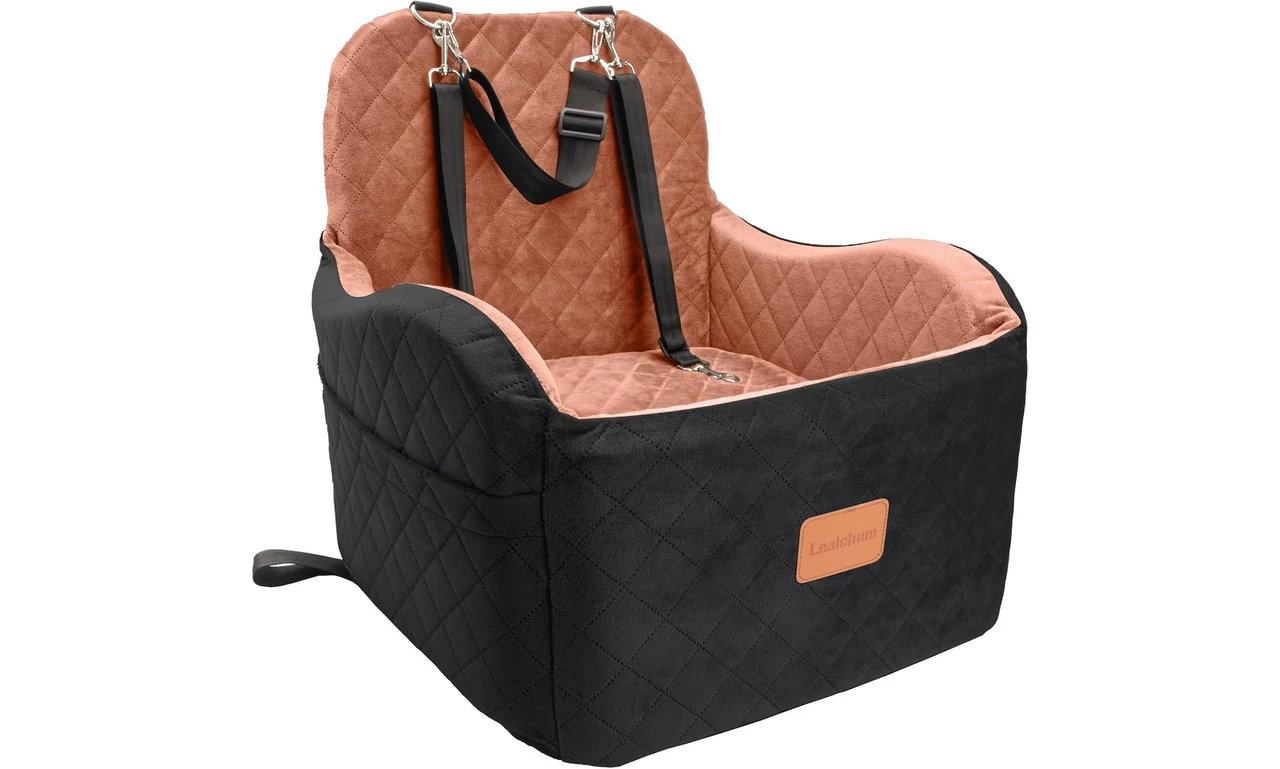
Lealchum 6-inch Elevated Booster
The Lealchum is our top pick for Frenchies specifically because it gets the breed-relevant details right. The 6-inch lift gives a Frenchie standing room without forcing them to crouch, the cushion is firm enough to absorb vibration but soft enough for a chondrodystrophic spine, and the side panels are low enough that hot air clears the dog rather than pooling around them.
The trade-off is price. At $76.88 it sits at the top of the booster category. If your Frenchie is anxious, runs hot, or you do regular highway driving, the upgrade is worth it.
Check price on Amazon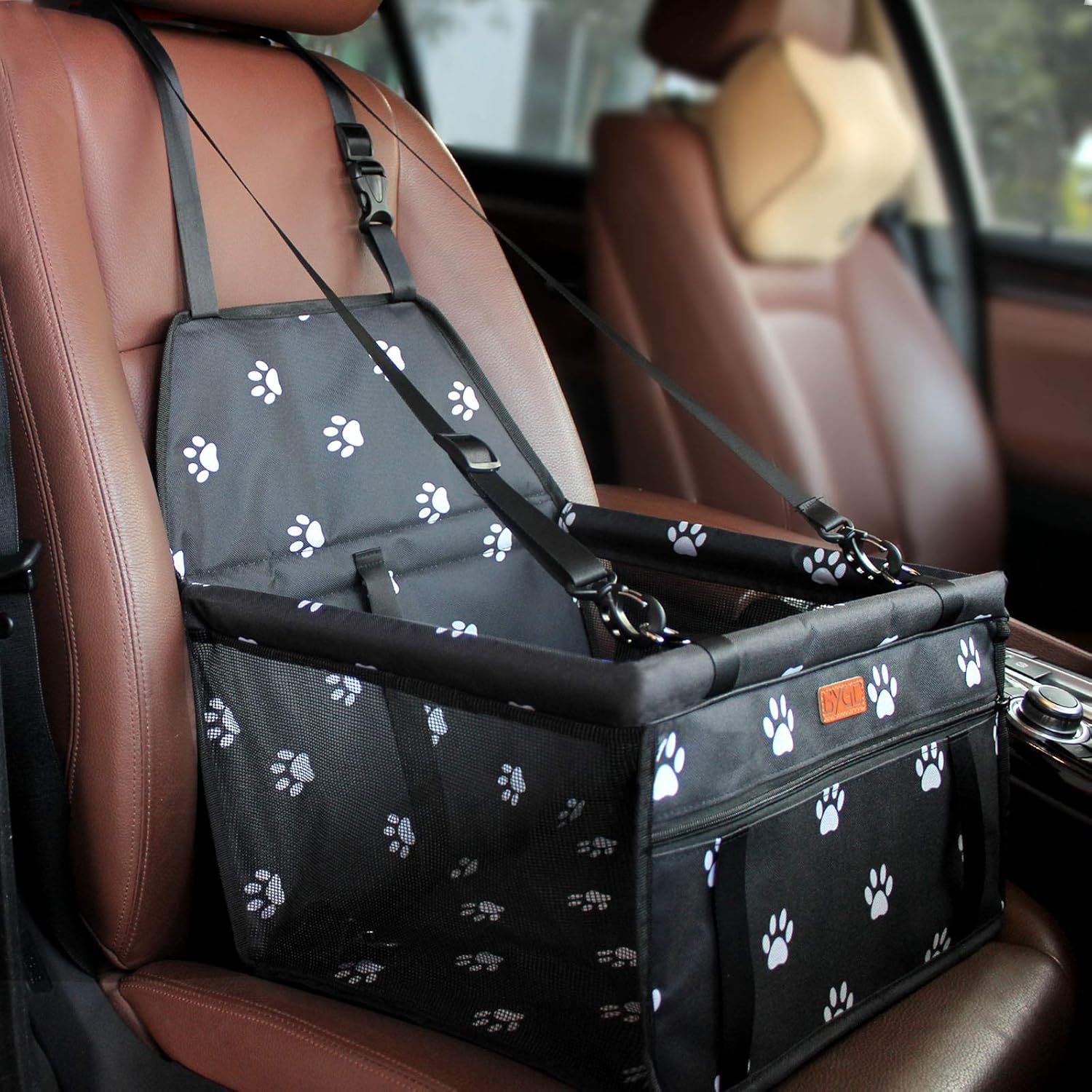
BYGD Breathable Basket Booster
The budget pick that happens to suit a brachycephalic breed. The open Oxford-mesh basket sides move air around the dog instead of trapping heat against it, which is exactly what a Frenchie that cannot pant efficiently needs, and the upgraded internal support rod keeps the basket from collapsing under a 20-plus pound dog. It folds flat when not in use. The 4.0 rating reflects a basic build rather than premium cushioning, so for highway IVDD comfort step up to the memory-foam pick; for short warm-weather trips on a budget it is hard to beat at around $15.
Check price on Amazon
Petbobi Reinforced Breathable Booster
The Petbobi is the budget pick that earns its place specifically for brachycephalic breeds. The mesh side panels are larger than most competitors, the cushion is thinner (a fair trade in hot climates where airflow beats padding), and the price means you can replace it annually if it wears out.
The 4.2-star rating is the lowest in our top 5 and reflects two real complaints: the cushion compresses faster than memory foam, and the metal frame is stiffer than the padded boosters. For an air-conditioned car in the Pacific Northwest, this is the wrong seat. For a Frenchie owner in Florida who needs the ventilation more than the cushion, it is the right one.
Check price on Amazon
PETICON Waterproof Memory Foam Booster
If your Frenchie is over 6 or has early-stage IVDD, the memory-foam cushion is the upgrade that matters most. Six inches of high-density memory foam absorbs the highway vibration ordinary polyfill transmits straight into a chondrodystrophic spine, and the 26 lb capacity covers average and upper-range Frenchies better than the 25 lb foam alternative. The 100 percent waterproof liner under a washable cover handles the drool and shedding the breed is known for. Weigh a heavy male show-line dog first, since some hit 28 lbs.
Check price on Amazon
Top tasta Soft-Sided Carrier
Not every drive needs a booster. For a vet visit, a groomer run, or any in-cabin trip under 15 minutes, a soft-sided carrier is faster to load and gives the dog a den-like enclosure that lowers stress. The scratch-resistant polyester shell over a one-piece steel frame holds its shape, and the mesh panels keep airflow moving for a brachycephalic dog. The 15 lb capacity fits puppies and smaller adult Frenchies; a typical 22 lb adult should step up to a soft crate instead.
Check price on AmazonComparison at a glance
| Pick | Price | Rating | Best for | Capacity |
|---|---|---|---|---|
| Lealchum 6-inch Elevated | $76.88 | 4.8 (2,266) | Frenchies overall | Up to 35 lbs |
| BYGD Breathable Basket | $15.03 | 4 (3,568) | Best value, breathable | Small/medium dogs |
| Petbobi Breathable | $18.99 | 4.2 (10,405) | Hot climates, max airflow | Small-medium dogs |
| PETICON Memory Foam | $39.99 | 4.6 (144) | Older Frenchies, IVDD-prone | Up to 26 lbs |
| Top tasta Carrier | $20.99 | 4.6 (1,420) | Vet trips, puppies | Up to 15 lbs |
Prices and ratings refresh weekly via our Amazon Creators API pull. The "as of" date on each product card in our booster category page is the last refresh timestamp.
How to fit the harness (the part that actually does the safety work)
The booster contains the dog. The harness restrains them. For Frenchies, the harness fit deserves more attention than for most breeds because their barrel-shaped chest sits in an awkward spot for off-the-shelf sizing.
- Measure the chest girth at the widest point. For an adult Frenchie that is usually 22 to 26 inches, just behind the front legs.
- Measure the neck. Frenchies have notably thick necks for their body size. A harness sized by chest girth alone often strangles them. Look for adjustable neck straps, not fixed-circumference designs.
- Fit the harness over the sternum, not the throat. The chest plate should sit on the breastbone. A harness that rides up onto the trachea is dangerous for any dog and especially dangerous for a brachycephalic one.
- Two-finger rule. You should be able to slide two flat fingers between the harness and the dog's body at the chest, back, and neck. Tighter restricts breathing; looser slips off in a crash.
- Walk the dog in it for 10 minutes before the first drive. A harness that gets dragged out only for car trips becomes a stressor. Use it on walks for a week first so the dog associates it with leaving the house, not specifically with the car.
Travel safety specifics for French Bulldogs
Heat and AC
The single most-cited cause of French Bulldog vet emergencies in summer is heat-related distress in cars. The cabin temperature of a parked car can rise 30 degrees Fahrenheit in 30 minutes even on a 70-degree day. For a Frenchie, that crosses from uncomfortable to medically dangerous fast. Two practical rules:
- Never leave a Frenchie alone in a car, even with the windows cracked. The breed's heat tolerance is materially worse than the general dog population's.
- Run AC on any drive over 10 minutes, even on cool days. A Frenchie panting from stress raises the cabin temperature and humidity together. Active cooling resets the loop.
Motion sickness
Brachycephalic breeds are over-represented in motion sickness clinic visits. The combination of compromised airway, easy nausea, and limited visual horizon (they cannot see far through a windshield) makes long drives genuinely unpleasant for many Frenchies.
What helps:
- Elevate the dog so they can see the horizon. A 6-inch booster fixes this for most Frenchies. Motion sickness in dogs is reduced when their inner ear and their eyes agree on what is happening.
- Empty stomach is not the answer. For most dogs, a small meal 60 to 90 minutes before driving actually reduces nausea. Speak to your veterinarian.
- Prescription anti-nausea medication exists. Cerenia (maropitant) is widely prescribed for travel-related nausea and is effective for most dogs that respond to behavioral changes alone. This is a conversation with your vet, not an Amazon purchase.
Vet visits and air travel
Two scenarios fall outside the standard "drive to the park" use case.
Vet visits
For routine clinic visits, a soft-sided carrier is faster, lower-stress, and gives the technicians something to lift the dog in and out of without putting them on the cold floor. The Top tasta carrier at $20.99 covers the puppy and small-adult range. For a typical 22-lb adult, the Amazon Basics 4-Door Soft Crate at $73.49 is the standard recommendation.
Air travel
Most major US airlines either prohibit brachycephalic breeds in cargo entirely or require veterinary clearance forms. The reason is a documented elevated mortality rate for snub-nosed breeds in cargo conditions. For Frenchies, the only realistic air travel option is in-cabin under-seat, which means an airline-approved soft carrier sized to fit the airline's specific dimensions. Check your airline's pet policy before booking, not after.
The Amazon Basics Airline Approved Soft-Sided Carrier ($31.49, 28,821 reviews) meets most US carrier dimensions, but verify against your specific airline's policy.
For the full ranked list of dog booster car seats, including options for dogs outside the Frenchie weight range, see our main booster category page. For soft-sided carriers and travel kennels, see the car carriers page.
Frequently asked questions
What weight should a dog car seat support for a French Bulldog?
Adult French Bulldogs typically weigh 16 to 28 lbs. Choose a booster rated for at least 30 to 35 lbs to give yourself headroom and avoid frame deformation. A seat rated exactly at 25 lbs may still work but offers no margin if your dog gains weight or sits on the upper end of the breed range.
Are Frenchies too brachycephalic for normal dog car seats?
Not too brachycephalic for the standard booster category, but airflow matters more than for non-brachycephalic breeds. Look for boosters with mesh panels or low sidewalls, and always run AC on drives over 10 minutes. The breed is at higher risk for heat-related distress in any enclosed space.
Can a French Bulldog use a hammock-style car seat cover?
Yes, for owners with SUVs or for use as a back-seat protector underneath a booster. The hammock by itself is not a crash restraint, and Frenchies are usually small enough that a dedicated booster is a better primary product. A hammock makes a good secondary layer to protect upholstery and prevent the dog from sliding into the footwell.
Is a soft-sided carrier safe enough for a Frenchie?
For short trips under 15 minutes and for vet visits, yes. For any drive longer than that, switch to a booster anchored to the seat belt with a separate harness. Soft carriers contain the dog but do not restrain them in a crash; the booster plus harness setup does.
What harness should I use with the booster?
Look for a crash-tested harness from brands that publish test results, sized to your Frenchie's chest and neck independently. Frenchies have thick necks relative to their chest, so adjustable neck designs fit better than fixed-circumference ones. The chest plate should sit on the sternum, not the throat. See our safety guide for what to look for in a harness.
Can a Frenchie ride in the front seat?
No. Front-seat airbags can kill or seriously injure a dog the size of a French Bulldog when they deploy. Always put the dog in the back seat, in a booster or carrier anchored by the seat belt. This is the same rule that applies to children under a certain weight and height.
How often should I replace the booster?
Replace the harness clip and the interior tether annually as a wear item. Replace the booster itself when the cushion compresses below 2 inches under your dog's weight, when the seat belt loops fray, or when the metal frame deforms. For most boosters used daily, that is 18 to 36 months of use.
My Frenchie hates the car. What should I do first?
Make sure the seat fits, the cabin is cool, and the dog is restrained without the harness compressing the chest. If those are right and the dog still struggles, motion sickness or anxiety may be the cause. Talk to your veterinarian about Cerenia for travel-related nausea, or about a behavioral plan. Forcing a Frenchie into a stressful seat repeatedly worsens both the airway and the behavior.