Hammock vs bench dog car seat covers.
The two main dog car seat cover styles solve different problems. Here is which one fits your vehicle, your dog, and how you actually use the back seat.
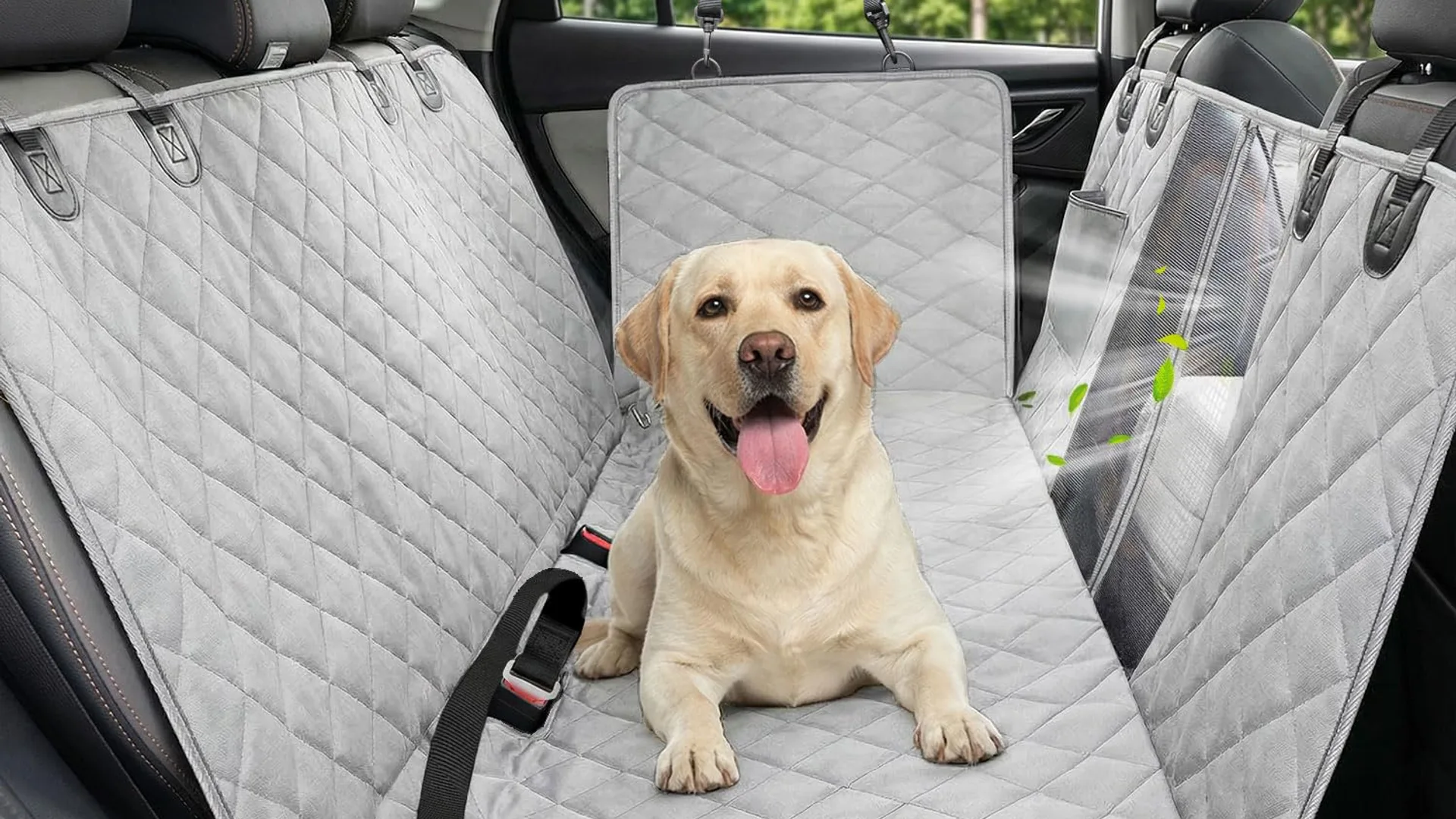
Two styles dominate the dog car seat cover category: the hammock and the bench. They look superficially similar (a quilted fabric piece that goes on the back seat), but they solve fundamentally different problems and fit very different use cases.
This guide compares the two on the dimensions that actually matter for daily use: which dog they fit, which vehicle they fit, what they protect, and where each one fails.
What each style actually is
Hammock-style cover
A hammock cover is a large rectangular fabric piece with four straps. Two straps anchor to the back-seat headrests, two anchor to the front-seat headrests, and the fabric drapes in a “U” between them, creating a deep pocket where the dog rides. The bottom of the U sits on the back seat cushion; the front and back walls extend up to the headrests; the front wall blocks the dog from falling into the front footwell.
The hammock occupies the full back seat width. There is no room for human passengers in the back when a hammock is installed (some hammocks have a “convertible” mode that folds half the cover up for passenger use).
Bench-style cover
A bench cover is a flat or slightly contoured fabric piece that covers the back-seat cushion and back rest, with anchoring straps to the rear headrests. There is no front-seat anchor and no front wall. The dog sits or lies on the bench cover the same way it would sit on the bare seat, just with a fabric layer in between.
Bench covers leave the rear footwell open, which means the dog can fall into the footwell during a hard stop. Bench covers are also typically narrower than hammocks; some only cover the bench cushion and not the seat back.
Side by side
| Dimension | Hammock-style | Bench-style |
|---|---|---|
| Best for dog size | Medium and large dogs | Small dogs in boosters |
| Footwell protection | Yes (front wall) | No |
| Rear passenger compatible | No (or convertible) | Yes |
| Cargo area extension | No | Sometimes (combo bench + cargo) |
| Anchor count | 4 (two front, two back) | 2 (rear only) |
| Typical price | $30 to $80 | $20 to $50 |
| Install time | 2 to 5 minutes | 30 seconds |
When the hammock is the right answer
The hammock’s defining feature is the front wall. That feature solves the most common dog car problem for medium and large dogs: the dog falls into the rear footwell during hard braking, then either stays stuck there for the rest of the drive or scrambles up onto the seat back, both of which are stressful and dangerous.
- Medium and large dogs (25+ lbs). They are too big for boosters and tend to lie flat on the back seat. The hammock prevents the foot-well fall and gives them a deeper “den” to settle into.
- Long road trips. A hammock’s deeper footprint means the dog has more room to stretch out and sleep, which most do within an hour.
- Vehicles where the back seat is dog-only. If you do not regularly carry rear passengers, the hammock’s full-coverage approach is genuinely better.
- Dogs that shed heavily. The hammock contains hair to a smaller area than a bench cover, which often leaves the seat back partially exposed.
When the bench is the right answer
The bench cover’s strength is what it does not do. Because it does not span between the front and back seats, the back footwell stays clear for human passengers. The bench cover is the right answer when:
- You have small dogs in boosters. The booster is doing the containment job; the bench cover is just protecting the upholstery from fur and dirt.
- You regularly carry human passengers in the back. A bench cover lets a person sit normally; a hammock generally does not.
- You drive a vehicle with bucket back seats. Hammocks are designed for bench seats. Bucket seats with a center console between them do not anchor a hammock cleanly.
- You want a quick install. Bench covers go on in 30 seconds. Hammocks take a few minutes.
The hammock is for dogs that ride alone. The bench is for dogs that share the seat with humans.
Fabric and construction details that matter
Within each style, the price and quality differences come down to fabric weight, waterproofing, and stitching:
Fabric weight
- 600D Oxford polyester. The baseline for “heavy duty” in this category. Holds up to most dogs through multiple wash cycles. Found at the $30 to $50 price point.
- 900D Oxford polyester. Significantly more abrasion resistant. Holds up to claws and chewing through years of use. Found at the $50 to $80 price point.
- Below 600D. Thin “scratch protector” weight. Tears within months. Avoid.
Waterproof backing
Most decent covers have a polyurethane (PU) backing that prevents drool, mud, and accidents from soaking through to the upholstery. Confirm the listing says “waterproof” not just “water resistant.” The backing should be visibly continuous, not stitched in panels.
Mesh window (hammocks only)
A clear mesh panel between the front and back of a hammock lets you see and reach the dog without lowering the cover. Without it, the hammock acts as a wall that blocks vision and access. Hammocks without a mesh window are usable but feel claustrophobic for the dog and isolating for the driver.
Stitching
Look for double-stitched seams at the corners and the strap attachment points. These are the high-load wear points. Single stitching tears within months under any meaningful tension.
Common installation mistakes
- Skipping the center tie. The hammock sags into a deep valley.
- Loose headrest straps. The cover slides forward under acceleration; the dog ends up against the front seat backs.
- Wrong-direction install. Some covers have a “front” and “back” indicated by tag placement. Installing reversed often leaves the seat-belt cutouts in the wrong position.
- Not removing the headrests for thick straps. A few hammocks have strap loops that do not slide easily over headrests. Pop the headrests off, slide the loops on, and reinstall.
- Using a bench cover with a medium-large dog. The dog falls into the footwell on the first hard stop and stays stuck there.
The recommendation, in one sentence
If your dog is medium or large and rides alone in the back seat, get a hammock with a 600D or 900D Oxford fabric, a center tie, and a mesh window. If your dog is small and rides in a booster, or you regularly carry rear passengers, get a bench cover at the $30 to $50 price point. For both, prioritize fabric weight over fancy features.
Our category page on dog car seat covers ranks the highest-purchased options on Amazon, with notes on fabric weight, waterproofing, and which include the center tie.
Frequently asked questions.
What is the difference between a hammock and a bench dog car seat cover?
A hammock-style cover drapes between the front and back headrests, creating a deep pocket with a front wall that prevents the dog from falling into the footwell. A bench-style cover sits flat on the back seat only and leaves the footwell open. Hammocks are better for medium and large dogs; bench covers are better for small dogs in boosters or when humans share the back seat.
Which cover style is safer?
A hammock provides better containment for medium and large dogs because the front wall keeps the dog from falling into the footwell during hard braking. Neither style is a crash restraint by itself; both should be used with a properly fitted harness for crash safety.
Will a hammock cover work in a sedan?
Yes, hammock covers are designed for sedan, SUV, and minivan back seats with bench-style configurations. Vehicles with bucket back seats and a center console between them are usually not compatible.
Can I use a bench cover for a large dog?
Technically yes, but the dog will fall into the footwell on hard braking. For dogs over 25 lbs that ride loose on the back seat, a hammock is significantly more practical.
How do I keep a hammock cover from sagging?
Use the center tie strap that anchors to the seat belt latch in the middle of the back seat. Hammocks without a center tie sag severely under any medium to large dog. If your hammock did not come with one, an aftermarket center strap is inexpensive.
Are these covers waterproof?
Most decent covers (600D Oxford and up) have a polyurethane waterproof backing. Confirm the listing says “waterproof” and not just “water resistant.” Below 600D fabric weight, waterproofing claims are usually thin and short-lived.
See our top dog car seat covers.
We rank the highest-purchased dog car seat covers on Amazon by purchases, ratings, and review volume. Both hammock and bench styles included, with notes on fabric weight and key features.
View top covers →