Best dog car seat for Pug: 5 brachycephalic-aware picks.
Pugs are the most-brachycephalic of the popular small breeds. Compromised airway, eye prominence, and heat sensitivity make the car-seat choice a medical conversation. We rank 5 picks chosen specifically for the breed.
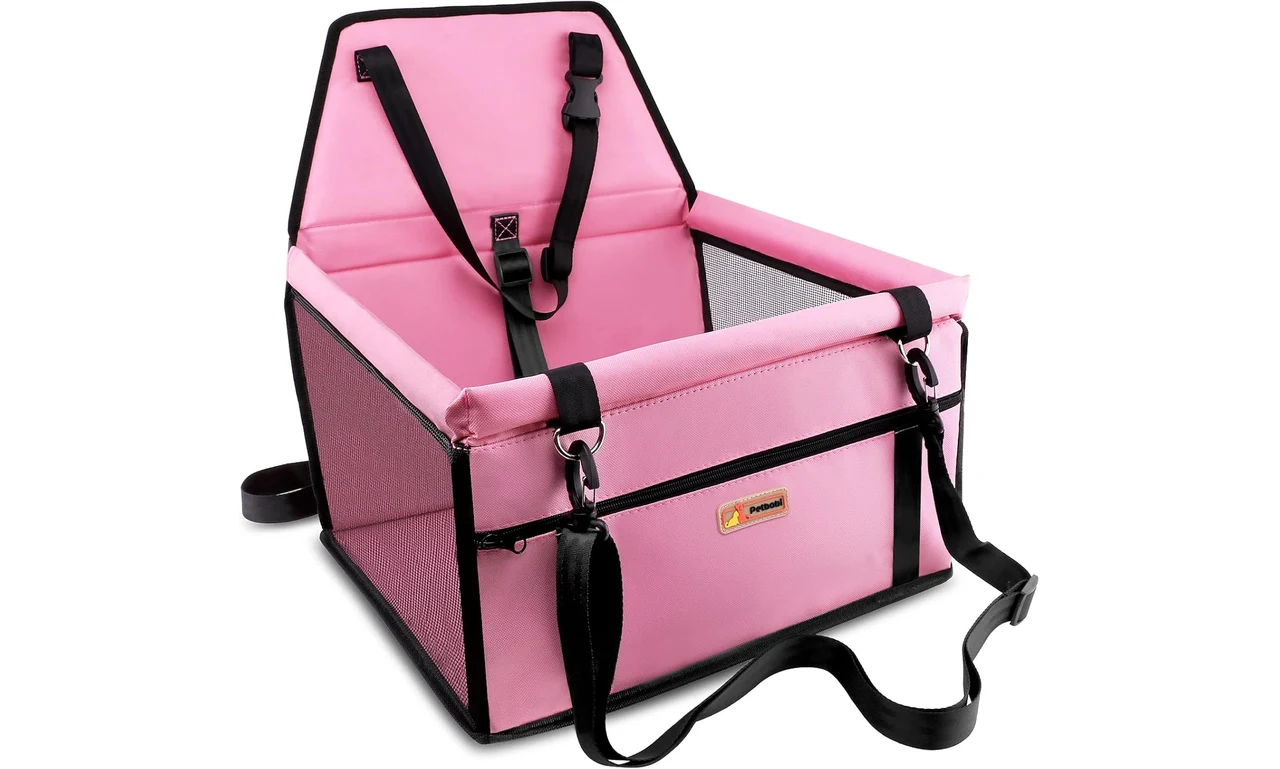
Pugs are the most-brachycephalic of the popular companion breeds, with airway constraints that exceed even French Bulldogs by some clinical measures. The breed has been bred for an exaggerated facial profile that maximizes the BOAS spectrum (Brachycephalic Obstructive Airway Syndrome). The car-seat decision for a Pug is therefore a medical conversation, not a cosmetic one.
If you arrived from the French Bulldog guide, most of the principles apply. The Pug-specific differences are smaller body size (which means more options fit), worse airway constraints on average (which means ventilation matters more), and the documented prevalence of eye injuries from sudden stops (which the booster choice can partly mitigate).
Why Pugs need special consideration
BOAS, more pronounced than in Frenchies
Brachycephalic Obstructive Airway Syndrome in Pugs typically includes stenotic nares (narrowed nostrils), an elongated soft palate, and tracheal hypoplasia (narrowed windpipe). The combination produces audible breathing at rest in most adult Pugs and clinical respiratory distress under heat or stress. The car amplifies both heat and stress.
Implications for car-seat choice:
- Ventilation matters more than padding. A high-walled, deeply-padded booster traps body heat against the dog. A breathable mesh-sided booster lets heat dissipate.
- Harness fit cannot compress the chest. A harness too tight across the sternum restricts diaphragm movement, which is already compromised by BOAS.
- AC is non-negotiable. Pugs cannot pant efficiently to cool themselves. Active cooling from the AC is the only reliable heat management.
Eye prominence and braking forces
Pugs have shallow eye sockets and prominent (proptotic) eyes. Sudden deceleration can cause the eye to displace forward, in severe cases requiring emergency surgical replacement. A booster that contains the dog in a stable position reduces the risk of the dog being thrown into the front of the seat during hard braking.
What this means practically:
- The booster sidewalls should be padded. Hard-edged frames are dangerous if the dog is thrown forward into them.
- The tether length matters. A short interior tether (6 to 12 inches) prevents the dog from building momentum before the tether catches.
- Smooth driving is more important than for non-brachycephalic breeds. Avoid hard braking when possible.
Our 5 picks for Pugs
1. Petbobi Reinforced Breathable Booster (best for Pugs overall)
Price: $18.99 | Rating: 4.2 stars (10,405 reviews) | Capacity: Small to medium dogs. The breed-specific top pick. Open mesh side panels (the largest mesh ratio in our top 5) maximize airflow and prevent heat from pooling around the dog. The cushion is thinner than competitors, which is the right trade-off for brachycephalic breeds: in this weight class, airflow beats deep padding. The 4.2-star rating is the lowest in our top 5 and reflects shorter cushion lifespan than memory foam alternatives, but for the breed-specific use case it is the right product. Check current price on Amazon.
2. iBuddy Cover with Mesh Window (best if your Pug rides on the bench)
Price: $28.49 | Rating: 4.6 stars (9,135 reviews) | Coverage: Bench seat with center mesh. Not a booster but a seat-cover hammock; included because some Pugs prefer to lie flat rather than sit elevated. The center mesh window provides both line-of-sight to the driver (reduces anxiety) and direct airflow (reduces heat). For Pugs that hate being elevated, this is the alternative configuration. Check current price on Amazon.
3. Memory Foam Elevated Booster (best for senior Pugs)
Price: $33.96 | Rating: 4.6 stars (1,755 reviews) | Capacity: Up to 25 lbs. For senior Pugs with joint stiffness or disc degeneration, memory foam absorbs the road vibration that ordinary polyfill transmits to the spine. The 6-inch lift also gives the dog visual access to the horizon, which helps with motion sickness. Capacity to 25 lbs is appropriate for the breed (most Pugs cap at 18 lbs). Check current price on Amazon.
4. BurgeonNest Dog Car Seat (best multipurpose pick)
Price: $39.99 | Rating: 4.6 stars (10,074 reviews) | Capacity: Small dogs. The most-purchased small-dog booster on Amazon. The dual booster/home-bed design helps with Pug anxiety because the dog associates the booster with comfort, not the vet. The trade-off for brachycephalic breeds is that the sidewalls are taller than the Petbobi, which traps slightly more heat. Run AC and this works for most Pugs. Check current price on Amazon.
5. Vceoa Soft-Sided Carrier (best for vet trips)
Price: $19.99 | Rating: 4.8 stars (37,444 reviews) | Capacity: Up to 16 lbs. For routine vet visits, the soft-sided carrier is faster to load, lower stress, and gives the dog a den-like enclosure. The 16-lb capacity fits typical adult Pugs (the breed standard is 14-18 lbs, with most pets in the 14-16 lb range). For Pugs over 16 lbs, see the Amazon Basics 4-Door Soft Crate at $73.49. Check current price on Amazon.
Comparison at a glance
| Pick | Price | Rating | Best for | Key feature |
|---|---|---|---|---|
| Petbobi Breathable | $18.99 | 4.2 (10,405) | Default Pug pick | Maximum mesh airflow |
| iBuddy Mesh Cover | $28.49 | 4.6 (9,135) | Pugs that lie flat | Center mesh + airflow |
| Memory Foam Elevated | $33.96 | 4.6 (1,755) | Senior Pugs | Vibration absorption |
| BurgeonNest | $39.99 | 4.6 (10,074) | Anxious Pugs, multipurpose | Doubles as home bed |
| Vceoa Soft Carrier | $19.99 | 4.8 (37,444) | Vet trips, short drives | Den-like enclosure |
Heat management for Pugs
The single most-cited cause of Pug vet emergencies in summer is heat-related distress, often after a short car trip with insufficient cooling. Pugs cannot pant efficiently because of the airway constraints, so they cannot cool themselves the way other breeds can. Two practical rules:
- Never leave a Pug alone in a car, even briefly. The cabin temperature of a parked car rises 30 F in 30 minutes even on a 70 F day. For a Pug, that crosses from uncomfortable to medically dangerous fast.
- Run AC on any drive over 5 minutes, even on cool days. A Pug panting from anxiety raises the cabin temperature and humidity together. Active cooling resets the loop.
Harness fit for Pugs
Pug harness fit is critical because the chest is barrel-shaped and the neck is thick relative to the head. Standard “small dog” harnesses often do not fit well.
- Measure chest girth at the widest point, typically 18 to 24 inches for adult Pugs.
- Measure neck separately. Pug necks are wider than the breed-size category implies; adjustable neck designs fit better than fixed-circumference.
- Chest plate forward of the trachea. The plate sits on the breastbone, not the throat. For a brachycephalic dog with tracheal hypoplasia, this matters even more than for other breeds.
- Two-finger fit, with no compression of the chest at rest. A harness that feels “snug enough” on a calm dog will be too tight when the dog inhales hard from stress or heat.
Motion sickness and short trips
Pugs are over-represented in motion sickness clinic visits, similar to French Bulldogs. The combination of compromised airway, anxious temperament, and limited visual horizon makes long drives genuinely unpleasant for many Pugs.
What helps:
- Elevate the dog so they can see the horizon. A 6-inch booster fixes this. Motion sickness in dogs is reduced when their inner ear and their eyes agree on what is happening.
- Acclimate gradually. Start with 5-minute drives ending at positive destinations. Build up over weeks.
- Cerenia is available by prescription for dogs with persistent motion sickness. Speak to your veterinarian; this is a medical conversation, not an Amazon purchase.
For the full ranked list of dog booster car seats and soft-sided carriers, see our booster category page and carrier page.
Frequently asked questions.
What is the best car seat for a Pug?
The Petbobi Reinforced Breathable Booster ($18.99, 10,405 reviews) is our breed-specific top pick because of its open mesh sides. Pugs are brachycephalic and cannot cool themselves efficiently; ventilation matters more than deep padding for the breed.
Are Pugs really at higher risk for heat distress in cars?
Yes. Pugs cannot pant efficiently because of the airway constraints of BOAS. A car cabin that is comfortable for you may be too warm for a Pug. Always run AC on any drive over 5 minutes, never leave a Pug alone in a car, and watch for early signs of heat distress (thick foamy saliva, louder than baseline breathing, gum color change).
Should I use a soft carrier or a booster for my Pug?
For drives over 15 minutes, use a booster paired with a harness clipped to the seat belt. For routine vet visits or trips under 15 minutes, a soft-sided carrier is lower stress and fits typical adult Pugs (up to 16 lbs in the Vceoa carrier).
Can my Pug ride in the front seat?
No. Front-seat airbags can kill or seriously injure a dog the size of a Pug when they deploy. Always put the dog in the back seat, in a booster or carrier anchored by the seat belt.
What about Pugs with eye problems?
Pugs with prominent eyes (most of the breed) are at risk of proptosis (forward displacement of the eye) from sudden deceleration. Use a short interior tether (6 to 12 inches) to prevent the dog from being thrown forward, and choose a booster with padded sidewalls rather than hard-edged frames. Drive smoothly and avoid hard braking when possible.
How tight should my Pug’s harness be?
Two fingers should slide between the harness and the dog’s body, with no compression of the chest when the dog is calm. A harness that feels appropriate on a calm Pug will be too tight when the dog inhales hard from stress or heat. Look for adjustable chest and neck straps independently.
Does my Pug need a special harness?
Pugs benefit from harnesses with the chest plate well-padded and forward of the throat. The barrel-shaped chest does not fit standard small-dog harnesses well; adjustable designs from brands that specifically size for brachycephalic breeds are worth the small premium.
See the full ranked list of dog booster car seats.
Our booster category page ranks the highest-purchased boosters on Amazon by review volume, rating, and price. Prices refresh weekly via the Amazon Creators API.
View all booster seats →