
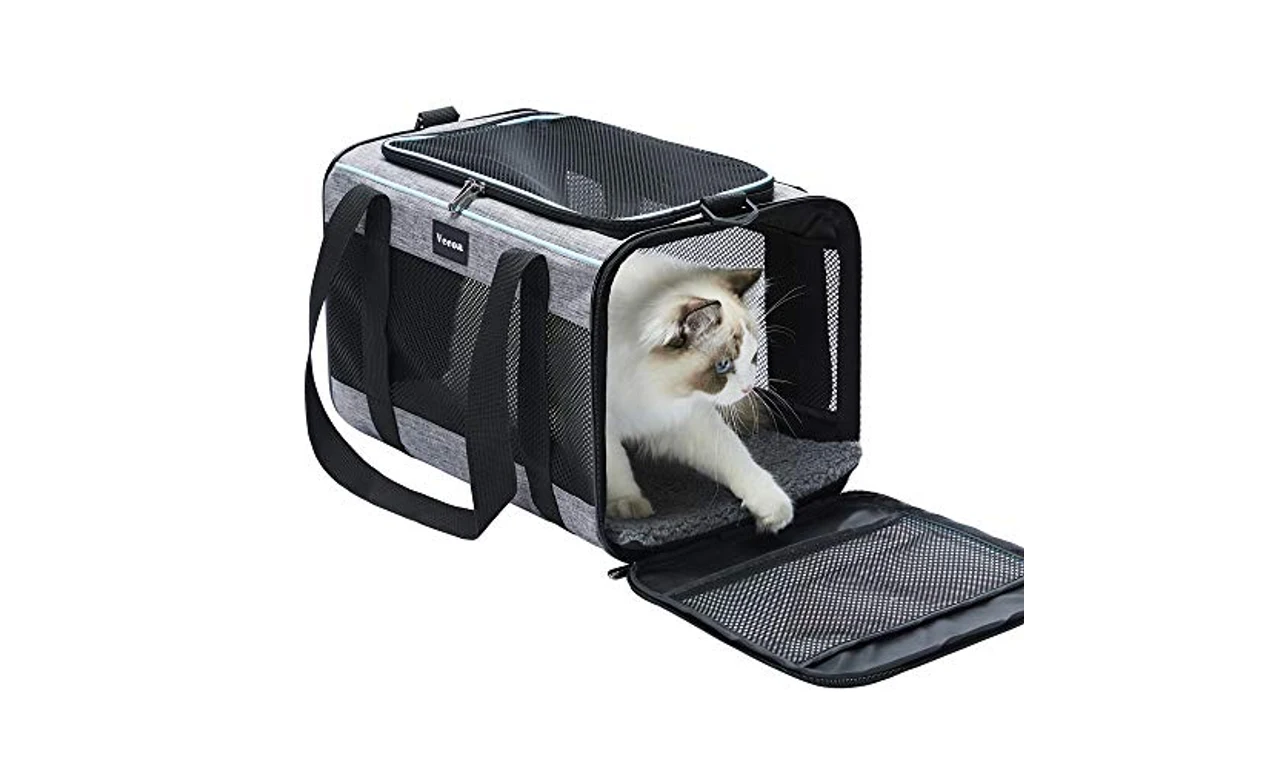
Best dog car seat for puppies (2026): 5 picks for safe first rides
Key takeaways
- For the first 8 to 12 weeks (or until the puppy weighs 8 to 16 lbs), a soft-sided carrier is the right setup. The enclosed space reduces stress and is faster to load than a booster.
- After the carrier phase, transition to a booster or hammock as soon as the puppy is too tall to stand up in the carrier comfortably. Most puppies outgrow the Vceoa carrier ($19.99, 37,444 reviews) by 4 to 5 months.
- Motion sickness is more common in puppies than adults; the inner-ear vestibular system finishes developing around 6 months. Elevation so the puppy can see the horizon helps significantly.
- The first 15 car rides should end at positive destinations (parks, friend's houses) at least 3 out of 4 times. A puppy that learns "car = vet" will develop lifelong car anxiety.
- A washable memory-foam booster that doubles as a home bed (melafa365, $49.99) reduces stress because the puppy associates the booster with sleep before they associate it with the car.
Puppies are not small adult dogs. Their bodies, behavior, and tolerance for car travel are different in ways that change which products work. A 12-week-old puppy weighing 4 lbs has different needs than the same puppy will at 8 months weighing 35 lbs, and the products you start with are usually not the products you finish with. This guide walks through the typical puppy progression and ranks five products that cover the common stages.
If you are about to bring home a brand-new puppy from a breeder or shelter, you need product 1 below before the pickup ride. The other four are sequential, ranging from the first 8 weeks through the first year.
The puppy car-travel timeline
Weeks 8 to 12: First rides
Most puppies come home from a breeder or shelter at 8 weeks. The pickup ride is often the puppy's first time alone in a vehicle, and it sets the tone for the next year. A soft-sided carrier is the right choice for three reasons: it contains accidents (almost guaranteed on the first ride), it gives the puppy a den-like enclosed space that reduces stress, and it allows easy handover if a second person is in the car.
Weeks 12 to 20: Vet visits and socialization
Puppies need 3 to 4 vet visits in the first 4 months for the puppy vaccine series. Each visit is a chance to associate the car with positive outcomes (treats, vet techs, recovery snuggles at home) or negative ones (cold exam tables, restraint, needles). Keep the carrier setup through this phase; the consistency itself is a stress reducer.
Weeks 16 to 30: Transition to booster or hammock
Once the puppy is too tall to stand up in the carrier comfortably (usually around 16 to 20 weeks for medium breeds, later for large breeds), switch to a booster or seat-cover hammock. The transition should happen at home first: put the new product on the floor or couch, let the puppy explore it, feed meals on it. Then introduce it to the car.
Months 6 to 12: Confident car-dog phase
By 6 months, most puppies are confident car riders if the first 5 months went well. The booster or hammock becomes the routine setup. Motion sickness usually resolves by 8 to 12 months as the vestibular system matures. By 12 months you have a settled adult-pattern car dog.
Our 5 puppy picks

Vceoa Soft-Sided Pet Carrier
The most-purchased soft-sided pet carrier on Amazon, with the highest rating in the category. Three-mesh ventilation, soft fleece interior, sherpa-lined removable pad. Fits puppies from 8 weeks up to roughly 4 to 5 months for medium breeds (longer for small breeds). The right first carrier for almost any puppy pickup. Has a seat belt loop on the strap for back-seat anchoring during the ride.
Check price on Amazon
melafa365 Memory Foam Booster
The right transition product after the carrier phase. The washable removable cover handles the accidents a young puppy is still prone to, the memory foam gives a settling comfort, and the 35 lb capacity means it grows with a medium puppy through most of the first year instead of being outgrown in two months. Let the puppy use it as a home bed for two weeks first so it smells like their nap spot, and they load up willingly once it goes in the car.
Check price on Amazon
Petbobi Reinforced Breathable Booster
Open-mesh sides for maximum airflow. The right choice for summer-born puppies and households where the car is regularly used in 80+ F weather. Puppies overheat faster than adults because their thermoregulation is immature. The mesh sides let body heat dissipate rather than pooling around the dog. Less padded than the memory-foam booster, but the ventilation advantage is meaningful for hot climates.
Check price on Amazon
Tomkas Small Dog Sling Carrier
For toy-breed puppies (Yorkies, Chihuahuas, Maltese) under 5 lbs that are too small for a soft carrier, a sling-style pouch worn cross-body is the right setup for short trips. The puppy sits at the human's torso level, calms from body warmth and heartbeat, and is contained without being enclosed. Best for short trips to the vet or socialization outings; not appropriate for trips over 30 minutes.
Check price on Amazon
Henkelion Cat & Dog Carrier
An alternative to the Vceoa with a more structured shape and an airline-approved option for owners who plan to fly with the puppy in the first year. Slightly more padding than the Vceoa, slightly tighter interior dimensions. The right pick if airline travel is in the puppy's near future; otherwise the Vceoa is the better default.
Check price on AmazonComparison at a glance
| Pick | Price | Rating | Best for | Key feature |
|---|---|---|---|---|
| Vceoa Soft Carrier | $19.99 | 4.8 (37,444) | First ride home | 3-mesh ventilation |
| melafa365 Memory Foam | $49.99 | 4.7 (1,375) | Transition after 16 weeks | Washable, doubles as home bed |
| Petbobi Breathable | $18.99 | 4.2 (10,405) | Summer puppies | Maximum mesh airflow |
| Tomkas Sling | $17.99 | 4.3 (29,141) | Toy puppies under 5 lbs | Body-warmth calming |
| Henkelion Carrier | $20.23 | 4.6 (52,486) | If airline travel is planned | Airline-approved sizing |
Preventing car anxiety in puppies
Car anxiety is one of the most-common adult dog behavior problems we hear about from owners, and most of it traces to the first 15 car rides. Three rules to prevent it:
- End at positive destinations 3 out of 4 trips. If 100 percent of your puppy's car trips end at the vet, the puppy will associate the car with vet visits. Park trips, friend's-house visits, drive-thru windows where the puppy gets a treat, all break the negative association.
- Make the first few trips short. 5 to 10 minutes total. A puppy locked in a carrier for an hour on the first ride is overwhelmed. Build up duration gradually.
- Reward calm behavior, not loading. Praising a puppy for getting into the carrier is fine, but the more important reinforcement is praising calm behavior during the ride and on arrival. Treats and praise should happen when the puppy is settled and quiet, not when they are barking or whining.
Motion sickness in puppies
Puppies vomit in the car more than adults. Two reasons:
- Vestibular system immaturity. The inner ear and balance system finishes developing around 6 to 12 months. Until then, the brain receives mismatched signals from eyes and ears, which causes nausea. This usually resolves on its own with age.
- Anxiety amplification. Stressed dogs (including puppies) produce more saliva and have slower gastric emptying, both of which raise the likelihood of vomiting. Reducing the stress reduces the vomiting.
What helps:
- Drive on an empty stomach. Skip the meal in the 90 minutes before the trip. A puppy with food in their stomach is more likely to vomit than one without.
- Crack the windows. Even 1 inch of open window changes the cabin air enough to reduce nausea. Do not fully open windows; puppies can lean out.
- Elevate so the puppy can see the horizon. Motion sickness in dogs is reduced when their eyes can see the moving landscape. The booster or hammock should let the puppy see out the window at adult eye height, not just at the door panel.
- Ask the vet about Cerenia. For persistent motion sickness, Cerenia (maropitant) is a prescription anti-nausea drug approved for dogs. It is safe for puppies over 8 weeks at appropriate doses. A 4-week course while the puppy adapts often breaks the pattern.
Car-safety setup for puppies
Even small puppies need restraint. A 4 lb puppy unrestrained in the cabin is dangerous in three ways: it can become a projectile in a sudden stop, it can crawl into the driver's foot well and cause loss of control, and it can be sat on or stepped on accidentally. The carrier solves all three.
Setup rules:
- Back seat only. Airbags can kill or seriously injure small dogs at deployment force. Always put the carrier or booster in the back seat.
- Anchor the carrier with the seat belt. Most soft-sided carriers have a seat-belt strap slot. Use it. An unanchored carrier slides during turns and stops.
- Never put a puppy on a passenger's lap. The puppy becomes a projectile in a crash. Lap-riding is the highest-risk position in the vehicle.
For the full ranked lists, see our carrier category and booster category.
Frequently asked questions
What is the best car seat for a puppy?
For the first ride home and the first 4 to 5 months, the Vceoa Soft-Sided Carrier ($19.99, 37,444 reviews) is our overall pick. After the puppy outgrows the carrier (around 16 to 20 weeks for medium breeds), transition to the melafa365 Memory Foam Booster ($49.99) which doubles as a home bed.
When can I take my puppy in the car?
Immediately. The pickup ride from breeder or shelter is usually the first car trip, and it sets the tone for the next year. Have the carrier set up in the back seat before pickup, and plan a short calm drive home with no unnecessary stops.
Why does my puppy throw up in the car?
Two main reasons: the inner-ear vestibular system is still developing until 6 to 12 months (immature balance equals motion sickness), and stress amplifies nausea. Drive on an empty stomach, crack the windows, elevate so the puppy can see the horizon, and ask your vet about Cerenia for persistent cases.
Should my puppy ride in my lap?
No. Lap-riding is the most-dangerous position in the vehicle. In a sudden stop, the puppy becomes a projectile or is crushed against the dashboard by the human chest. A 4 lb puppy in a 30 mph crash carries enough force to break bones. Use a carrier or booster in the back seat.
How do I prevent my puppy from getting car anxiety?
End trips at positive destinations (parks, friends' houses) at least 3 out of 4 times. Keep the first 5 to 10 trips short, under 15 minutes. Reward calm behavior during and after the ride, not the initial loading. A puppy that learns "car equals fun" stays that way for life; a puppy that learns "car equals vet" develops anxiety.
Can I leave my puppy alone in a soft carrier in the car?
Never, even for a minute. Cabin temperatures rise 20 to 30 degrees F in 10 minutes on a warm day. Puppies have less thermoregulation capacity than adults. A puppy left in a carrier in a parked car can develop heat distress within minutes. Always take the puppy with you when you exit the vehicle.
What about the seat belt for a puppy harness?
For puppies under 4 to 5 months, the carrier is the right setup, not a harness-and-tether. Once the puppy graduates to a booster or hammock (around 5 to 6 months), introduce the harness gradually: wear it at home for short periods first, then short car trips, then full trips. A puppy that fights the harness in the car has not been desensitized to it; the fix is more home practice, not a different harness.