
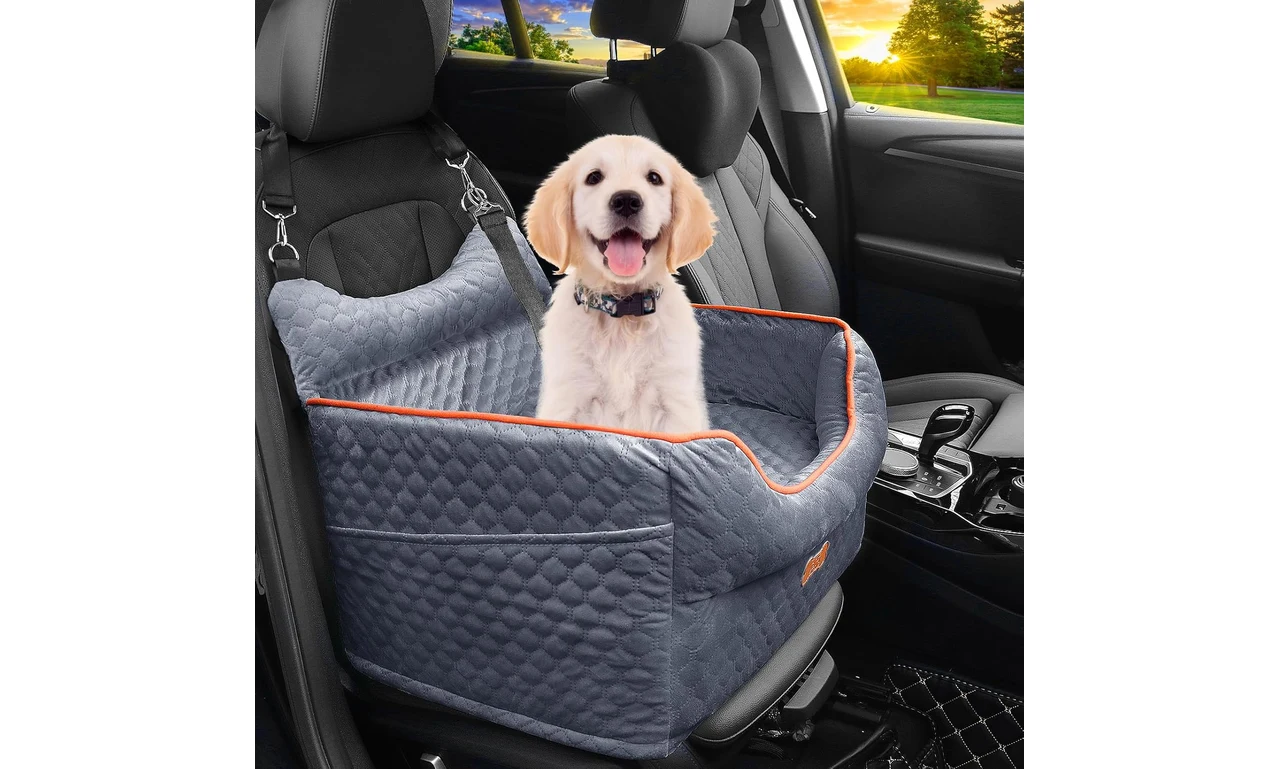
Best dog car seat for Dachshund: 5 IVDD-aware picks for 2026
Key takeaways
- Dachshunds have an estimated 15 to 25 percent lifetime risk of intervertebral disc disease (IVDD), the highest of any breed per multiple peer-reviewed studies (DachsLife 2015 reported 15.7% overall, with Standard Smooth-Haired Dachshunds at 24.4%). The car is one of the most common triggers because of jumping in and out and sustained crouching during drives.
- Booster height matters more than for any other small breed. A 6-inch elevated booster keeps the spine neutral; a 2-inch flat pad forces a long-backed dog to crouch for the entire trip.
- Memory foam absorbs road vibration that ordinary polyfill cushions transmit directly to the spine. For Dachshunds over five years old, memory foam is the single most-important specification.
- A car ramp at the door is not optional for Dachshunds over six. Jumping in and out of a sedan is the single highest-load motion a Dachshund spine experiences in daily life.
- The Memory Foam Elevated Booster ($39.99, 1,755 reviews, up to 25 lbs) is our overall pick. The melafa365 memory-foam booster ($49.99, 1,375 reviews, up to 35 lbs) is the upgrade for larger standard Dachshunds that still need the vibration absorption.
Dachshunds are the breed most often described as "shaped wrong on purpose." The chondrodystrophic genetics that produced their signature long body and short legs also produced the highest IVDD rate of any breed. About one in four Dachshunds will have at least one disc episode in their lifetime, and roughly half of those will require surgical intervention. The car is one of the most common triggers because daily life includes jumping in and out of vehicles and lying in awkward positions for the duration of a drive.
This guide picks car seats specifically against IVDD risk. If your Dachshund is under three and has never had a disc episode, you have more flexibility. If they are over six, have shown stiffness, or have any history of disc disease, the seat choice is part of the medical management.
Why Dachshunds need a different conversation
The chondrodystrophic spine
Chondrodystrophic dogs (Dachshunds, Corgis, French Bulldogs, Basset Hounds) have intervertebral discs that calcify earlier than non-chondrodystrophic breeds. By age three, many Dachshunds already have visible disc degeneration on radiographs even without clinical signs. The discs are most likely to herniate during specific motions: jumping down from a height, twisting the spine, and sustained crouching that compresses the vertebral column.
What this means for a car seat:
- Crouching is bad. A flat booster forces the dog to keep their spine flexed for the entire drive. Even a 30-minute commute, repeated daily, accumulates load on already-compromised discs.
- Vibration is bad. Highway expansion joints transmit road vibration through the vehicle frame, through the bench seat, through a thin booster pad, and into the dog's spine. Memory foam interrupts that path. Polyfill does not.
- The jump into and out of the car is worst of all. A Dachshund jumping down from a sedan back seat lands with the force concentrated on the front legs and transmitted through the spine. A ramp or carry is the preventive measure.
What to look for in a Dachshund booster
| Spec | What to look for | Why it matters for Dachshunds |
|---|---|---|
| Lift height | 5 to 7 inches | Lets the dog stand without crouching. Below 4 inches forces sustained flexion. |
| Cushion material | Memory foam or high-density foam | Memory foam absorbs vibration; polyfill compresses and transmits it. |
| Cushion depth | 3 to 5 inches | Enough to absorb road feedback. Below 2 inches is a flat pad, not a cushion. |
| Interior length | 16 inches or more | A standard Dachshund is 14 to 18 inches long. The seat needs to fit the dog stretched out. |
| Side wall height | 6 to 8 inches | Tall enough to contain without forcing the dog to climb in or out, which is a jump-down motion. |
| Weight rating | Up to 25 lbs (mini) or up to 35 lbs (standard) | Mini Dachshunds: 8 to 11 lbs. Standard: 16 to 32 lbs. Choose with headroom. |
Our 5 picks for Dachshunds

Memory Foam Elevated Booster
This is the only booster in our top picks that combines memory foam with a 6-inch lift. For an IVDD-prone breed, that combination is the single most-important specification, and the price ($39.99) is reasonable for the spine protection it provides. Capacity caps at 25 lbs, which fits mini Dachshunds (8-11 lbs) and most standards (16-25 lbs). For larger standards over 25 lbs, see pick 2.
Check price on Amazon
melafa365 Memory Foam Booster
For standard Dachshunds in the 25 to 32 lb range, the melafa365 is the rare seat that pairs genuine memory foam with a 35 lb capacity, so a larger long-backed dog still gets the vibration absorption that protects compromised discs. The 17-inch interior length fits a stretched-out Dachshund instead of forcing it to curl, the washable removable cover handles accidents, and at $49.99 it is far cheaper than the premium alternatives while hitting the same IVDD-critical specs. For Dachshunds with diagnosed disc disease, this memory-foam upgrade is appropriate.
Check price on Amazon
ZOMISIA Waterproof Booster
The budget pick for younger Dachshunds with no IVDD history, where the memory-foam difference is still marginal. The elevated perch keeps the spine neutral instead of forcing the crouch a flat pad imposes, and the fully waterproof shell wipes clean after the accidents and muddy paws of a young dog. The cushion is supportive polyfill rather than memory foam, so for Dachshunds over five or with any disc history, step up to the Memory Foam pick (pick 1) instead.
Check price on Amazon
JOEJOY Deluxe Booster with Metal Frame
The internal metal frame is the differentiator. Polyfill cushions over a cardboard or plastic insert collapse within months of daily use; a metal frame holds the lift indefinitely. For owners who drive daily with a Dachshund, the lift consistency matters more than peak comfort on day one.
Check price on Amazon
LEHNI Collapsible Carrier
Dachshunds in IVDD recovery (post-surgical or during crate rest) need full containment, not a booster. The LEHNI gives the den-like enclosure veterinarians prescribe, and its internal steel frame and support board hold the shape so the structure cannot sag onto a dog ordered to stay still. Mesh on four sides keeps airflow and lets the dog see out to reduce stress, and the carrier secures to the seat with the belt. Mini Dachshunds under 16 lbs fit; standards size up to a soft crate.
Check price on AmazonComparison at a glance
| Pick | Price | Rating | Best for | Capacity |
|---|---|---|---|---|
| Memory Foam Elevated | $39.99 | 4.6 (1,755) | Overall, IVDD-aware | Up to 25 lbs |
| melafa365 Memory Foam | $49.99 | 4.7 (1,375) | Larger Dachshunds, memory foam | Up to 35 lbs |
| ZOMISIA Waterproof | $34.19 | 4.3 (420) | Best value, younger dogs | Up to 25 lbs |
| JOEJOY Metal Frame | $27.99 | 4.5 (2,004) | Daily-driver durability | Small dogs |
| LEHNI Carrier | $19.99 | 4.6 (1,118) | IVDD recovery, vet trips | Up to 16 lbs |
The ramp problem
No car seat fixes the jump in and out of the car. A Dachshund jumping down from a sedan back seat lands with the force concentrated on the front legs; the spine takes the deceleration. Over years, this is the single highest cumulative load on a Dachshund's spine, and it is the single most-preventable IVDD trigger.
Two solutions:
- A portable pet ramp. A folding ramp that deploys from the open car door turns the jump into a controlled descent. Look for ramps rated to at least 40 lbs (capacity headroom for a standard Dachshund plus a hand on their back during descent) and with a non-slip surface.
- Carry the dog in and out. For mini Dachshunds, a hand under the chest and one under the back hips lifts the dog without putting the spine in flexion. For standards over 20 lbs, the ramp is the practical answer.
The ramp is a separate purchase outside our booster category, but for an IVDD-prone breed it matters more than which booster you choose.
Harness fit for Dachshunds
Dachshund harness fit is unusual because the chest-to-neck ratio is reversed from a typical small dog: their chest is deep but narrow, and their neck is thick relative to their head. Standard "small dog" harnesses often do not fit.
- Measure chest girth at the deepest point (just behind the front legs), typically 14 to 22 inches.
- Measure neck circumference separately. Dachshund necks run 9 to 14 inches and are thicker than the breed-size category implies.
- Look for adjustable neck and chest straps. Fixed-circumference harnesses sized to "chest" alone often strangle Dachshunds.
- The chest plate must sit forward of the front legs, not behind them. A harness that rides back compresses the long body in flexion during a sudden stop.
Crate rest and surgical recovery
If your Dachshund has had a disc episode or surgical intervention, your veterinarian will prescribe a period of strict crate rest (typically 4 to 8 weeks). During this period, car trips are reduced to the minimum necessary (vet rechecks), and the in-car configuration changes:
- Use a soft carrier or hard-sided crate, not a booster. The dog should not be able to stand, turn around, or jump out.
- The carrier or crate must be secured to the seat with the seat belt, not free-standing on the floor.
- Drive smoothly. Avoid hard braking, fast corners, and rough roads. The recovery period is also a behavioral period; how the dog experiences the car during recovery affects how they perceive it after.
For the full ranked list of dog booster car seats and soft-sided carriers, see our booster category page and carrier page.
Frequently asked questions
What is the best car seat for a Dachshund?
For most adult Dachshunds, a 6-inch elevated booster with a memory foam cushion is the right answer. Our overall pick is the Memory Foam Elevated Booster ($39.99, 1,755 reviews) for Dachshunds under 25 lbs. For standards over 25 lbs, the melafa365 Memory Foam Booster ($49.99, 1,375 reviews, up to 35 lbs) is the upgrade.
Why does booster height matter so much for Dachshunds?
Dachshunds are chondrodystrophic, with a long back and short legs. A flat or low booster forces them to crouch for the entire drive, keeping the spine in flexion. A 6-inch lift lets them stand and turn around in a neutral spine position. For a breed with up to 25 percent lifetime IVDD risk, sustained spinal flexion is a real and preventable load.
Is memory foam really better than regular cushion for a Dachshund?
Yes, especially for highway driving. Memory foam absorbs the vibration that ordinary polyfill cushions transmit directly through to the spine. For a young Dachshund with no IVDD history, the difference is marginal. For a Dachshund over five, or with any disc history, memory foam is the single most-important spec on the seat.
Should I let my Dachshund jump out of the car?
No, especially after age six or with any history of back stiffness. The jump down from a sedan back seat lands the force on the front legs and transmits it through the spine. Use a portable pet ramp or carry the dog out. This is the single most-preventable IVDD trigger in daily Dachshund life.
My Dachshund has had IVDD surgery. What should I use in the car during recovery?
During the crate-rest period (typically 4 to 8 weeks post-surgery), use a soft-sided carrier or hard-sided crate that prevents the dog from standing, turning, or jumping. The carrier must be secured with the seat belt, not free on the floor. Drive smoothly and minimize trips. Follow your veterinarian's specific recovery protocol.
Do Dachshunds get motion sickness?
Some do, but it is less common than in brachycephalic breeds. Elevating the dog so they can see the horizon usually helps. If motion sickness persists, talk to your vet about Cerenia, the prescription anti-nausea medication for travel.
Can my Dachshund ride in my lap?
No. A dog of any size in the front seat is at risk of airbag injury in a crash, and a lap dog can be propelled into the windshield by deceleration force. The back seat in a booster anchored to the seat belt is the only appropriate location.