Best dog car seat for small dogs under 25 lbs.
Small dogs are the use case booster seats were designed around. Here is how to pick one that actually solves the problem, including the features that matter and the marketing language to ignore.
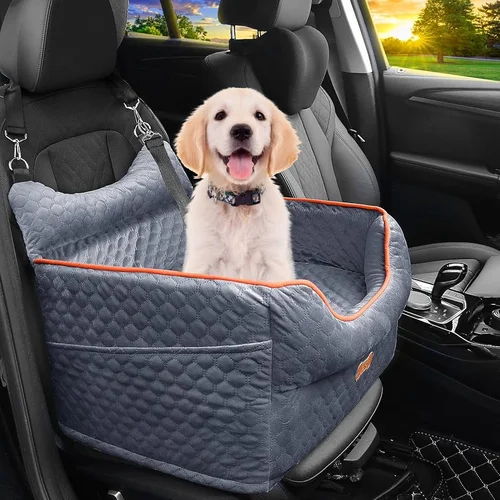
Booster seats were designed for one specific use case: small dogs riding in passenger vehicles. For that audience, when paired with a properly fitted harness, a booster is the most practical safety setup most owners will adopt and actually use. The harder question is which booster, given that there are several hundred near-identical-looking products on Amazon.
This guide walks through the features that actually differ between products, the price tiers and what each one buys, and the brand-agnostic checks you can run before purchase.
What “small dog” means for booster sizing
Most boosters list a maximum weight, and the products that show up for “small dog” searches typically support 10 to 25 lbs. The number to pay attention to is the internal width and depth, not the weight rating.
| Dog weight | Recommended internal width | Recommended internal depth |
|---|---|---|
| Under 10 lbs (toy breeds) | 10 to 12 inches | 12 to 14 inches |
| 10 to 18 lbs (small breeds) | 13 to 15 inches | 14 to 17 inches |
| 18 to 25 lbs (small/medium) | 15 to 17 inches | 17 to 20 inches |
If the listing does not give internal dimensions, only “fits dogs up to X lbs,” the product is sized broadly and may not fit a tiny dog well. A 6 lb yorkie in a booster designed for a 25 lb cocker spaniel will slide around inside the booster, which defeats the containment purpose.
The features that actually matter
1. Seat belt routing
The booster needs a clear, intuitive way to thread the back seat’s seat belt through it. Look for marked guides on the back of the booster (usually two webbing loops) and a lap-belt threading channel underneath. Boosters that “wrap around” the seat with elastic straps but do not engage the seat belt are not anchored, only positioned. They will move significantly in any hard stop.
2. Internal tether or harness anchor
Inside the booster, look for a metal D-ring or a heavy nylon webbing loop, riveted or sewn into the structural frame of the seat. This is what your dog’s harness will clip to. The cheap version is a small plastic clip on a fabric strap, which will fail under any meaningful load. The proper version is a metal ring rated for at least 50 lbs of pull force.
3. Fill and structure
Booster fill comes in three common varieties:
- Memory foam. The current standard at the $40 to $80 price point. Holds shape over months of use, supports the dog without compressing flat, and conforms to small body shapes.
- Polyester batting. Cheaper, found in $20 to $35 boosters. Compresses to almost flat within 60 to 90 days of regular use, after which the booster is just a fabric box.
- EPS or rigid foam. Found in higher-end boosters and in some “crash tested” claim products. More structured, slightly less plush, but maintains shape indefinitely.
For a small dog who rides in the booster more than once a week, memory foam or EPS is what you want. For a dog that rides once a month, polyester batting may be acceptable but expect to replace the booster within a year.
4. Removable, washable cover
Most boosters in this category have a removable outer cover. Confirm the cover is machine-washable (some are spot-clean only) and zips off the foam interior cleanly. A booster used for years collects a remarkable amount of fur, drool, and outdoor debris. If the cover does not come off, the booster will smell within months.
5. Side wall height and shape
Tiny dogs need higher side walls. A 5 lb dog in a flat-walled booster can climb out during normal driving and run around the cabin, which is not a safety failure of the booster but is a real driver-distraction problem. Look for at least 6 inches of side wall height for dogs under 10 lbs, and a slightly cupped or “bucket” shape rather than a flat box.
Price tiers and what each one buys
| Tier | Typical price | What you usually get | What you usually do not |
|---|---|---|---|
| Budget | $15 to $30 | Polyester batting, fabric clip, basic cover | Real seat belt routing, durable D-ring, washable cover |
| Standard | $35 to $60 | Memory foam, metal D-ring, washable cover, real belt threading | Independent crash test data, premium fabrics |
| Premium | $70 to $130 | Memory foam or EPS, multiple harness anchor points, premium covers, branded reputation | Substantial advantage over standard tier in actual safety |
| Crash-tested | $120+ | Documented test results, EPS or molded structure, branded harness integration | Cheap price |
The honest read on the price tiers: jumping from budget to standard ($30 to $50) buys real durability and safety improvements. Jumping from standard to premium ($50 to $100) mostly buys aesthetics and brand. Jumping to true crash-tested products buys verified safety performance, but the products are limited in number.
What to look for in product photos and listings
- Underside photos. A good listing shows the bottom of the booster with the seat belt threading channel visible. Sellers who hide the underside are usually hiding that there is no real anchoring system.
- Interior detail. The D-ring or harness anchor should be visible in at least one photo. If the listing shows only exterior shots, the interior anchor may be a basic plastic clip.
- Real customer install photos. Look at the customer-uploaded review images. They show the booster in real cars, with real dogs, and real installation choices.
- Dimensions in inches and centimeters, not just dog weight. Listings that only specify “for dogs up to 25 lbs” without internal dimensions are often the same product sold under multiple brand names.
How to install a small-dog booster correctly
- Position the booster on the back seat, ideally on the right side (passenger side) where you can reach in to check on the dog while parked.
- Thread the seat belt through the marked channels on the back of the booster. The lap belt should pass behind the booster and the shoulder belt should anchor it to the seat back.
- Click the seat belt into the buckle and pull the shoulder belt taut. The booster should not lift more than an inch when you pull up on it.
- Put the dog’s harness on first, fitted snugly (two fingers between harness and chest).
- Place the dog in the booster and clip the harness D-ring to the booster’s internal anchor.
- Adjust the internal tether so it has 4 to 8 inches of slack, no more.
- Test by pulling on the dog’s harness gently. The dog should not be able to step out of the booster, only sit, lie down, and turn around within it.
When a booster is the wrong answer
Boosters are not for every small dog. Skip the booster category if:
- Your dog is over 25 lbs. Even if a listing says “up to 30 lbs,” the materials and structure are not designed for that load. Move to a back-seat harness setup.
- Your dog has severe motion sickness. Some dogs are worse off elevated. A flat hammock-style cover with a harness may work better.
- Your car has bench seats with the seat belt buckles in inconvenient positions. Some older sedans have buckles that do not allow clean booster threading. Check before ordering.
- You are taking long road trips (4+ hours). Most boosters do not have enough internal space for a dog to fully stretch out and sleep. For long trips, consider a hammock cover that gives the dog room to move and lie down.
Our top picks
For the current top-purchased booster seats on Amazon, ranked by purchases, ratings, and review volume, see our full dog booster car seats page. The list refreshes regularly to reflect the live Amazon catalog. Each entry includes the affiliate link, current price, and our flag for whether the booster includes a usable internal harness anchor.
Frequently asked questions.
What is the best dog car seat for a small dog?
For dogs under 25 lbs, the best booster has memory foam fill, a metal D-ring as the harness anchor, marked seat belt threading channels, and a machine-washable cover. The current top-ranked options by Amazon purchase volume are listed on our boosters page, refreshed weekly.
How small is too small for a booster seat?
Dogs under 5 lbs are at the lower edge of the standard booster sizing. For very small dogs, look for a booster with internal width under 12 inches and side walls over 6 inches tall, or consider a smaller travel carrier instead.
Does my small dog need a harness if the booster has a built-in clip?
Yes. The clip on most consumer boosters is intended for containment in normal driving, not crash forces. A separately purchased crash-tested harness, sized to the dog, is what does the actual safety job during a collision.
Can I put the booster in the front seat?
No. Frontal airbag deployment can be fatal to small dogs even at low speeds. The back seat is the right place. Side or rear-facing seats with the airbag disabled are still riskier than the back seat.
How much should I spend on a booster seat?
The honest answer is between $35 and $60 for most owners. Below $30 you typically lose meaningful durability and safety features. Above $80 you mostly pay for aesthetics and brand, not safety performance, unless you are buying an explicitly crash-tested product.
Will a booster work in any car?
Most boosters work in any vehicle with standard back-seat seat belts. A few older sedans with awkward buckle positions may not allow clean threading. Check the rear seat belt geometry before ordering.
See our ranked dog booster picks.
We rank the top dog booster seats on Amazon by purchases, ratings, and review volume. The list refreshes regularly to reflect what current buyers are actually choosing.
View top booster seats →