Are dog car seats safe? What the crash data actually shows.
Independent crash testing has changed what we know about dog car safety in the last decade. Here is what the data shows, what to look for in a seat, and the marketing claims worth ignoring.
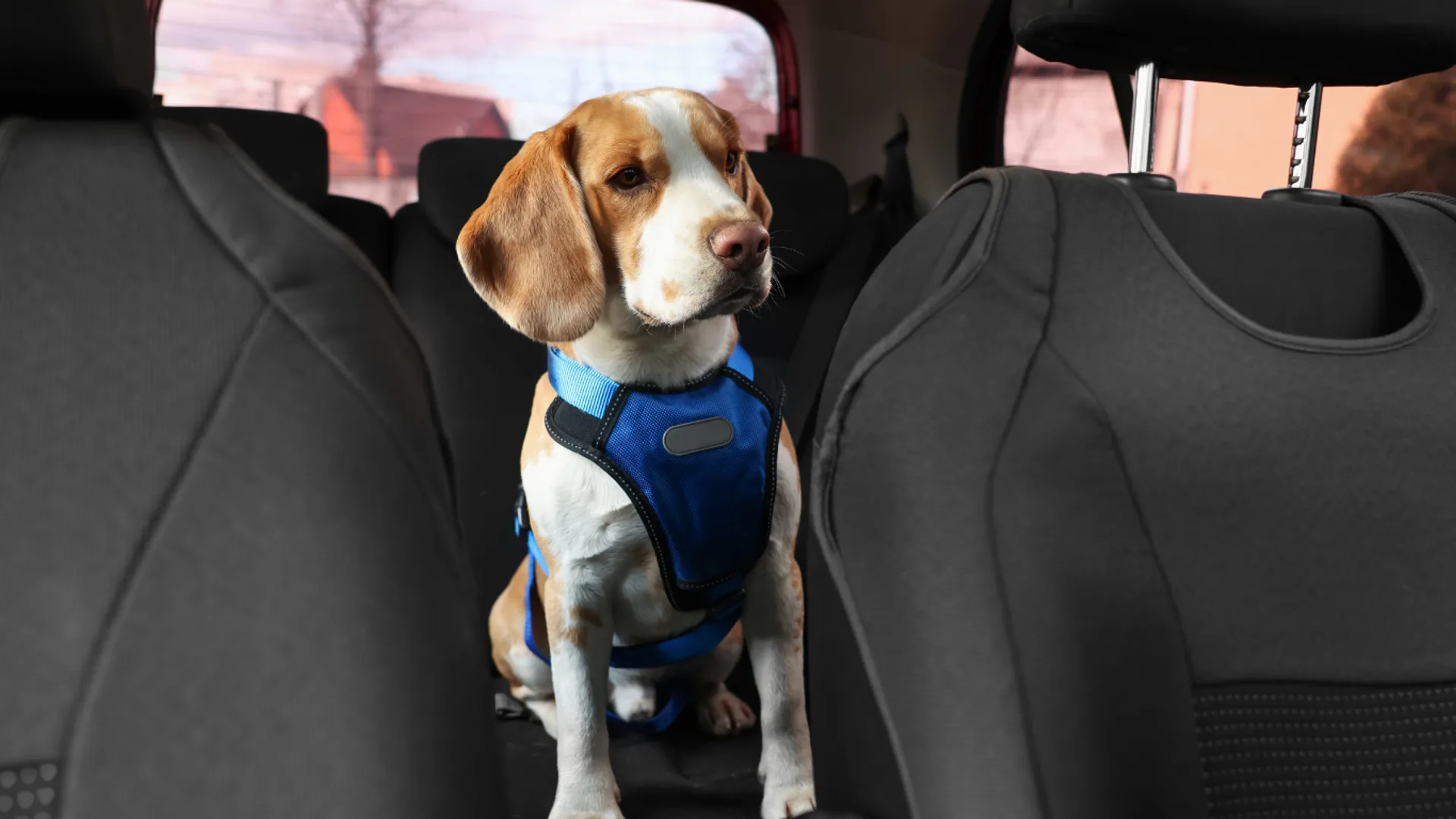
Most “dog car seat” products on Amazon are sold as safety equipment. Very few of them have been independently crash tested, and the marketing language that has become standard in the category, terms like “crash tested,” “safety certified,” and “vehicle approved,” is mostly unregulated. This guide explains what the actual data shows, what those terms mean in practice, and how to choose a product when the marketplace itself is not standardized.
We are not a lab. The information below is drawn from publicly available data from the Center for Pet Safety, AAA pet travel research, and manufacturer-published crash test footage where it exists. Where the evidence is thin or contested, we say so.
There is no federal pet car seat standard
In the United States, child car seats must meet Federal Motor Vehicle Safety Standard 213, which sets crash performance and labeling rules. There is no equivalent standard for pet products. A manufacturer can label a product “crash tested” without disclosing the test conditions, the dummy weight, the speed, or whether the product passed.
That regulatory gap is why the same product on Amazon may be marketed as “crash safe” in one listing and “for travel comfort” in another, with no functional difference between them. Owners reading the listing have no easy way to verify the claim.
What the Center for Pet Safety found
The Center for Pet Safety, a nonprofit research organization, has run independent crash testing on pet harnesses, carriers, and booster seats since around 2013. Their methodology uses dummy dogs of varying weights at speeds intended to simulate a 30 mph frontal impact, similar to FMVSS 213 conditions for child seats.
Two findings from their public reports stand out for owners:
- Most harnesses fail. In their 2013 round of harness testing, the majority of products on the market failed at the 30 mph standard. Subsequent rounds have shown improvement, but the pass list remains short and is dominated by a handful of brands that explicitly designed for the test.
- Booster seats are travel comfort, not crash equipment. Soft-sided booster seats, the dominant product category for small dogs on Amazon, are not designed to absorb crash forces. CPS recommends them only when paired with a separately crash-tested harness, not as a standalone restraint.
The implication is that the booster seat itself is doing one job, elevating the dog so they can see out the window and ride more comfortably, while the harness clipped to the seat belt is doing the actual safety job. Treating the booster as the safety product is a category error.
A booster seat without a properly fitted harness is a comfort accessory, not a restraint.
Center for Pet Safety, paraphrased
How crash forces actually act on a dog
In a 30 mph frontal collision, an unrestrained 20 lb dog can effectively become a 600 to 700 lb projectile. The force comes from kinetic energy: a small mass moving at car speeds carries enough force to break human bones, crack windshield glass, or crush the dog itself against a hard surface. This is the same physics that makes seat belts non-optional for human passengers.
Three failure modes are common in pet crash test footage:
- Harness webbing rips at the stitched seam. The harness was rated for walking force, not crash force. The seam was the weak point.
- Tether snaps free of the seat belt anchor. The harness held, but the loop or carabiner connecting it to the belt latch broke.
- The dog slides under or out of the harness. The harness was loose, or the design did not constrain the chest cavity properly under load.
These are real-world failure modes, not theoretical. They are also the reason that “crash tested” without a documented testing standard means very little: the harness might be tested only for failure mode 1 and not 2 or 3.
What “crash tested” should actually look like in marketing copy
When a manufacturer has done credible testing, the listing tends to read very differently. Look for these specifics:
| Acceptable signal | Why it matters |
|---|---|
| Named testing org (CPS, ADAC, MUTSCAN) | Independent labs publish methodology. Marketing teams cannot. |
| Test speed (e.g., 30 mph frontal) | Tells you whether the test simulates a real collision or a parking-lot bump. |
| Dummy weight tested (e.g., 25, 45, 75 lbs) | A harness rated for a 75 lb dog may fail catastrophically with a 25 lb one; harness sizing is non-trivial. |
| Year of test | Older tests may not reflect the current product. Materials and stitching change. |
| Pass/fail outcome stated explicitly | Some products advertise that they were “tested” without saying they passed. That distinction matters. |
If two of those five items are missing, the claim is unverifiable. That does not necessarily mean the product is unsafe, only that you cannot tell from the listing.
The harness is the load-bearing piece
Across crash testing organizations, the consistent finding is that the harness, not the seat, is what determines whether a dog survives a 30 mph collision. A booster seat or hammock can hold the dog in position, give them a comfortable ride, and prevent them from leaping into the front seats. None of that is the same as restraining a 60 lb mass under crash forces.
The practical setup that works for most dogs:
- Crash-rated harness, sized correctly for the dog (not too loose, not strangling), with the chest plate covering the sternum and the back strap sitting flat between the shoulder blades.
- Short tether, ideally 6 to 12 inches, connecting the harness ring to a seat belt latch or LATCH anchor. Long tethers allow the dog to build momentum before the tether catches.
- Booster seat or hammock as a comfort and containment layer, used in addition to the harness, not instead of it.
Where booster seats add real value
Even though boosters are not crash equipment, they solve real problems for small dogs and their owners. The case for a booster, when paired with a harness:
- The dog can see out the window, which reduces motion sickness in many dogs and reduces barking and whining caused by visual frustration.
- The dog stays in one place, instead of pacing across the back seat or trying to climb into the driver’s lap. Driver distraction is a measurable crash risk on its own.
- Soft fabric cushions normal driving forces, the kind your dog experiences hundreds of times before they ever encounter a crash. Comfort matters when most rides are uneventful.
The mistake to avoid is treating the booster as the safety product. The booster makes the ride better. The harness makes the ride survivable.
When a harness is not the right answer
For larger dogs, especially those over 50 lbs, a different setup may be more appropriate. The two main alternatives:
Crash-tested crate, strapped to the cargo area
For SUVs and station wagons, a hard-sided crate that has passed a recognized crash test, properly anchored with cargo straps to the vehicle’s tie-down points, is generally considered the safest option for medium and large dogs. The crate isolates the dog from the cabin entirely and absorbs deceleration through its frame.
The two failure modes here are: the crate not being anchored at all (most common) or the crate being anchored to the wrong points (cargo nets, soft hooks, or seat anchors not rated for the load).
Hammock-style cover with harness anchor
A hammock cover that drapes between the front and back seats can serve as a backup containment layer. If the harness fails, the hammock prevents the dog from being thrown into the footwell. It is not a primary restraint, but it is a sensible secondary one.
The unrestrained dog problem
The single most common pet car safety failure is the dog riding completely unrestrained. AAA research has consistently found that the majority of dog owners do not use any kind of restraint when their dog is in the car. The risks compound:
- Driver distraction. A loose dog moving around the cabin pulls the driver’s attention. AAA estimates pet-related distraction accounts for a measurable portion of distracted-driving incidents.
- Crash injury to the dog. The kinetic-energy math above applies. A 50 lb dog hitting a windshield at 30 mph is unlikely to survive.
- Crash injury to passengers. An airborne dog can kill a child in a rear-facing car seat or render an adult unconscious.
- Post-crash escape and bite risk. Even if the dog survives the impact, an injured and panicked dog may bite first responders or escape into traffic.
The first job of any restraint, even an imperfect one, is to keep the dog in one place. That alone solves the distraction and post-crash escape problems. Crash performance is a second-order concern.
How to choose, in three steps
- Decide on the restraint mode first. Booster + harness for small dogs (under 25 lbs), harness on the bench seat for medium dogs (25 to 50 lbs), crate or harness in cargo area for large dogs (50+ lbs).
- Choose the harness. Look for a published crash test result against a documented standard, sized to your dog. The harness brand matters more than the seat brand.
- Choose the seat or cover. Once the harness is decided, pick the seat or hammock that fits your vehicle and your dog’s preferences. The seat is the comfort layer.
Our category page on dog booster car seats ranks the highest-purchased booster products on Amazon, with notes on which include built-in safety belt anchors and which require a separately purchased harness.
Frequently asked questions.
Is a dog car seat actually a safety product?
A “dog car seat” sold as a soft-sided booster is primarily a comfort and containment product, not a crash-rated restraint. The crash safety job is done by the harness and the tether that connects the harness to the vehicle’s seat belt or LATCH anchor.
Are any dog car products federally regulated for crash safety?
No. Unlike child car seats which must meet FMVSS 213 in the US, pet products have no federal crash standard. Independent organizations like the Center for Pet Safety run their own testing programs, but compliance is voluntary.
What is the safest dog car seat for a small dog?
For dogs under 25 lbs, the safest setup is an elevated booster seat anchored to the back seat with the seat belt, paired with a separately purchased crash-tested harness. The booster keeps the dog in one place; the harness restrains them in a collision.
Can I just clip my dog’s walking harness to a seat belt?
Walking harnesses are designed for steady leash pressure, not crash forces. Clipping a walking harness to a seat belt is better than nothing for distraction prevention, but the stitching, hardware, and fit are usually not rated for collision loads.
Is a hammock-style cover safer than a booster seat?
They solve different problems. A booster elevates a small dog so they can see out and feel less anxious. A hammock cover prevents a larger dog from falling into the footwell during hard braking. Neither is a crash restraint by itself.
How do I know if a “crash tested” claim is real?
Look for the testing organization name, the test speed, the dummy weight, the year of the test, and the pass/fail outcome. If two or more of these are missing from the product page, the claim is unverifiable.
What about dogs over 50 lbs?
Large dogs are generally safer in a crash-tested hard-sided crate that is properly anchored to a cargo area, or in a crash-rated harness on the back seat. Soft-sided boosters do not scale to large-dog weights.
See our top picks for dog car seats.
We rank the highest-purchased dog booster seats on Amazon by purchases, ratings, and review volume. No sponsored placements.
View top booster seats →